Seismic and Petroleum
Seismic is one of the most important tools available to the petroleum geologist. It is a method used to determine the depth and orientation of rock formations without actually having to drill a well.
Although the working mechanics of the process are extremely complicated, the concept is simple.
Seismic On Land
The Seismic Process
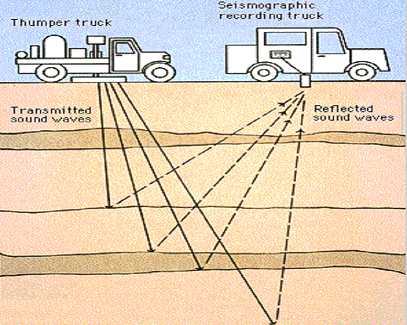
A source of energy is applied at the surface of the ground. This energy may be applied by a thumper truck, which uses a large, heavy iron plate to strike the ground. Sometimes, the source will be dynamite, placed in a shallow hole and exploded.
Sound waves from the source travel down into the ground and are reflected back by the rock layers back up to the surface. A system of listening microphones, or geophones, pick up the reflected sound waves. The simple picture shown here shows only one receiver. In practice, many such receivers are used at once. The more receivers used, the better the quality of the received data. The geophones, being spaced out at regular intervals, record the returning sound waves.
Seismic In The Ocean
In a similar way, seismic data can be acquired for the sea floor and the rock layers beneath the sea.
Marine Seismic
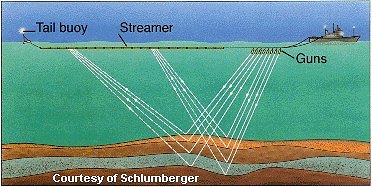
To do this, a ship at sea tows a sound source behind it. The source provides very strong waves of sound energy. This energy is often supplied by blasts of compressed air from air guns towed behind the ship. The sound waves penetrate the sea floor. They are then bounced off the rock layers, and are picked up by hydrophones (listening devices located on the streamer) towed behind the ship. The produced undersea data is processed the same way as land seismic.
Processing to Get 2D “Lines”
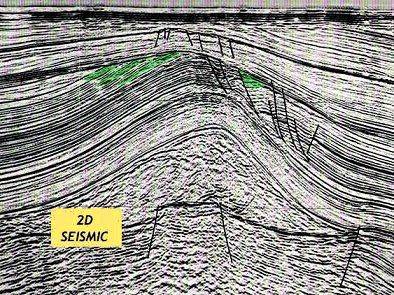
Once the data has all been “shot,” the information is fed into computers for processing. The result is a “line” showing the data (below). This line could have come from either a land or sea acquisition.
A Line of 2D Seismic
This line is a representation is the oldest type of seismic, and is called “2D” because the image has an x and y dimension, but no z dimension. In other words, the visual representation is like looking a flat piece of paper. It shows a single cross-section through the earth along a relatively straight line.
Layers of rock deep in the earth can be clearly seen. On this “2D” line, stratigraphic traps containing possible oil or gas have been shaded green by hand.
Computer technology for data processing continues to improve. Old lines can be re-processed using more modern techniques. Re-processing with newer methods can give a whole new look to old data, and reveal things that were previously unseen.
Processing the Data to Get “3D”
In the 1990’s, a new method of acquiring seismic became popular due to advances in computer design. The new product was called “3D” seismic. “3D” is shot much the same way as 2D, except that the “shotpoints” — or dynamite holes — are much closer together, and are laid out on a grid, instead of in a straight line.
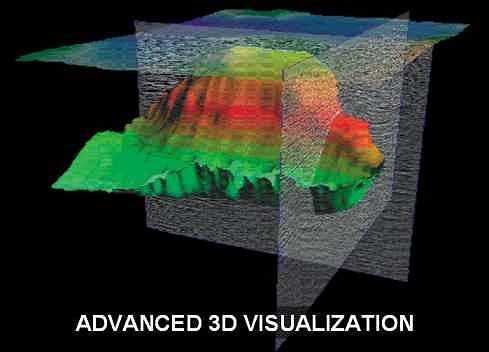
3D Seismic Visualization
The geophones that receive the reflected sound waves are also laid out in a grid. A huge data set is collected, and the data is processed by powerful computers. The result is a “3D data set” that can be manipulated on a computer to display fantastic three-dimensional images of the rock formations deep underground.
Seismic data can be used on the petroleum geologist’s maps to “fill in” areas where there is no well control.
Some petroleum geologists work their own lines. If the company owns a lot of seismic data, a geophysicist may be hired to handle the seismic duties.
Seismic Solves All The Problems?
You might think that 3D seismic would solve all the problems of the petroleum geologist. It’s not quite that simple.
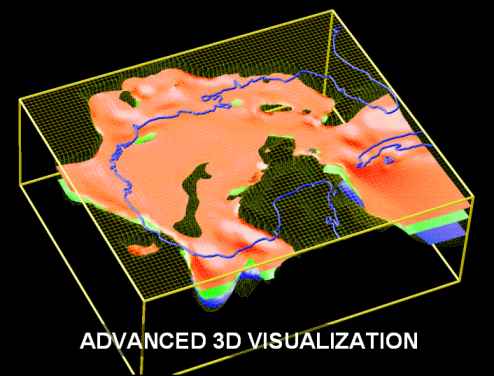
Advanced Visualization
3D is extremely expensive. Second, 3D is good at showing structural traps but not so good at showing stratigraphic traps. Finally, 3D cannot help the PG tell if the rocks contain oil or gas, since many traps are full of water, or the porosity might not be sufficiently-developed to call it a “trap” at all. Only by drilling a well can the presence of oil or gas be established. Look for this to change in the future!