Becoming a Geologist
I Discover I’m A Dork
As children, we were told that our primary responsibility was school, and everything else was secondary to that. My brother and I read encyclopedias constantly…for recreation. Neither of us went to the bathroom without an encyclopedia!
My father was always bringing home some cast-offs related to electricity. It might be a spark coil that could deliver a hefty jolt to your body one week, or a set of WWII field telephones the next, We always had plenty of 6-volt dry cells, rolls of wire, and solder to power up anything we might design. I disassembled stereos, telephones, and house wiring, and tried to get the stuff reassembled before my father got home. Mom never batted an eye when when she found me deep inside the stereo, the breaker box, or her mixer. One of my favorite afternoon activities was taking the back off the TV, pulling the vacuum tubes out, carefully examining each one, then replacing them.
I only cared for one thing: reading about science. When exposed to anything else, I had a full-blown case of ADD (Attention Deficit Disorder).
I played a lot of sandlot baseball and football at that time. However, I was simply covering up the fact that I was a certified dork.
Rocks Are Cool
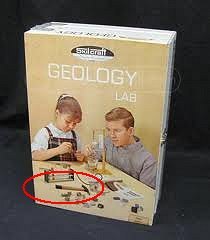
My First Geology Lab!
We lived on the east coast, what is referred to in geology as the “coastal plain.” There were very few exposed rock outcrops nearby. I read many books about adventures in gold or silver mines out west, simply because that was where the rocks and minerals were!
But, fossils could be found in our neighborhood, sometimes in strange places…fossilized shark’s teeth were abundant; my brother and I dug them out of the hot asphalt roads that melted in the summer.The Pleistocene teeth had made their way into the asphalt as fill material.
My uncle worked as a customs inspector at the large nearby port. He sometimes brought me a chunk of a rock or mineral that had come in by the boatload. Iron ore, chromium ore, asbestos (asbestos was quite “cool” in those days), bauxite, manganese, sulfur, or mica. These specimens meant more to me than toys.
In the 4th grade, I received a Skilcraft Geology Lab for Christmas! Santa had finally noticed my rock passion!
Oak Terrace Elementary School
Mr. J. Howard Berry was the principal at Oak Terrace Elementary School, in North Charleston, South Carolina. The school was later renamed J. Howard Berry Elementary School.
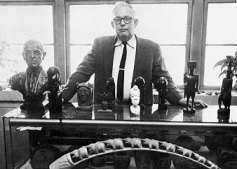
Mr. Berry In The Oak Terrace Library, 1962
Mr. Berry ran the school with an iron fist. He could show up in any class, any time — he was all over the place. Some people, probably many teachers, thought Mr. Berry was overbearing. My own mother thought he was overbearing. But I loved him. That was because Mr. Berry knew all about the fun things in the world. And those things were science and geology. I didn’t know it at the time, but I had encountered my very first Renaissance Man.
Mr. Berry was quite no-nonsense, and a little scary. But he truly loved to see kids learn things.
On any given day, we might be studying our dreaded math or history when Mr. Berry would pop into the room. The teacher would sigh, roll her eyes, and sit down. Mr. Berry had taken over the classroom. For the next 30 minutes, he might engage us with an impromptu french lesson, play selections of Sousa’s marches on a rickety old wind-up record player, or describe the gigantic stalactites in some cave in Peru. He knew how to fascinate students, and he put his heart into it. It was fairly obvious he would much rather teach than run the school!
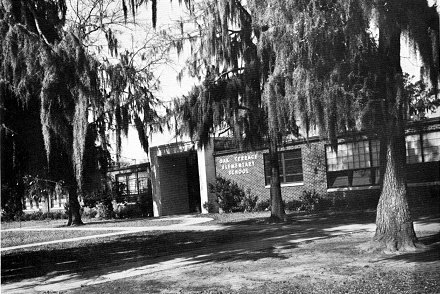
Oak Terrace Elementary School – Later J. Howard Berry Elementary School – North Charleston, SC
The Science Lab
Mr. Berry established a science lab at the school. Now, this was not just a room with a couple of dead frogs in it. This lab was packed to the gills with the most amazing dangerous stuff I could imagine. Chemicals-magnets-microscopes-bunsen burners-steam engines-gyroscopes-geiger counters-acid-scalpels-microscope slides. For the true science nerds, there was even a cloud chamber! All kinds of curiosities from all over the world. But most of all, the rocks. Hundreds of specimens of rocks and minerals. Mr. Berry loved anything scientific, but he especially loved earth science and geology. and he loved talking about rocks and minerals, looking at them, and handling them.
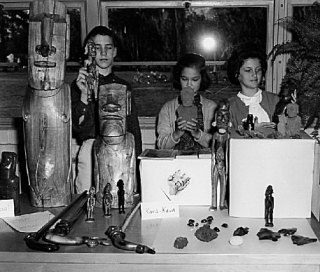
Artifacts from Easter Island – Science Lab – Oak Terrace
I have no idea where Mr. Berry got the money to build his science lab. No other schools around the area had anything like it. Even North Charleston High School, in the same town, didn’t have anything like it. But it was there, and you just had to show a little interest, and it was opened to you.
One day, Mr. Berry came to our classroom. He asked if anyone knew what was engraved on a certain linoleum block sitting in a case in the school library. Well, I had taken the time to look at the block once. So, I raised my hand, and told him the linoleum block was engraved with the Cherokee alphabet. As a reward, I was taken to his private darkroom, which he had installed at the school. We spent most of the afternoon taking photos, developing the film, and making prints. Then we took one of his large telescopes outside, and looked at sunspots on the sun. It was pretty close to magic.
Not The Pet
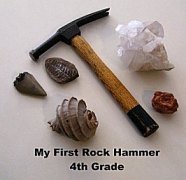
First Rock Hammer – 4th Grade
One might get the idea I was Mr. Berry’s “pet” from the above stories. Actually, he didn’t know me from Adam. This was just the kind of thing he did when any kid showed interest. He was totally ignorant of my identity. I was just another curious kid.
In fact, a few weeks after the Cherokee alphabet incident, I was summoned to his office for a reaming meant for another kid who possessed my exact first and last name. It took a full 5 minutes of stammering to convince him it was a case of mistaken identity. It was a narrow escape, as corporal punishment was still the rage then, and he was quite familiar with dealing it out.
Berry’s Science Camp
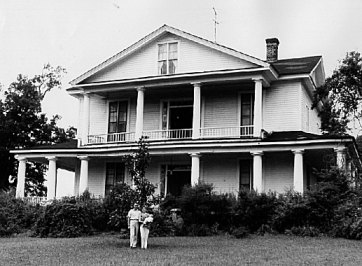
Mr. Berry’s Home – “Ingleside” – Liberty Hill, SC
Mr. Berry owned a country home called “Ingleside,” at Liberty Hill, South Carolina. Here he ran a science camp in the summer for interested students. One of the highlights of my life was being allowed to attend this camp.
There were perhaps 12 boys the year I went. Everything was planned out, and everything was about science, with geology being at the tip-top of the list. We slept in tents in a canyon at the back of his large property, with an outhouse for facilities. A couple of boys were singled out at the beginning of camp (perhaps their moms had advised him that their children were “sensitive”), and these unfortunates were quartered in the house with Mr. and Mrs. Berry. They were pitied. I much preferred the smelly old army tents!
I should point out that Mr. Berry was most definitely not anti-female; for some years previously he ran a camp at Spruce Pine, North Carolina, where he had facilities for both girls and boys. But this was his first year of running the camp at Liberty Hill, and the facilities were limited.
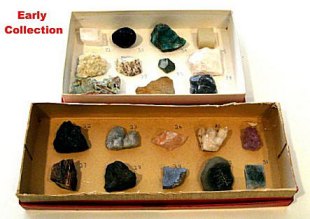
Part of My Early Rock Collection (Railroad Rocks)
Highlights at the camp included field trips to nearby sites of geologic interest. One trip involved a journey to a dangerous pegmatite mine that gave up garnets the size of of saltshakers. Mr. Berry thought children should be allowed to participate in “hazardous” activities…as long as they were pursuing the cause of science…better to be dead than stupid, he seemed to think. Mixing acids, flaming phosphorous globules, and scrambling up death-defying cliffs at abandoned mines was part of his strategy to keep things interesting. I’m afraid Mr. Berry could not get away with his camp nowadays!
Mr. Berry smoked like a fiend at the camp that year, but spent a whole lot of time coughing his lungs out and advising us boys that we should never smoke. Thankfully, I heeded this wise advice.
The best part came at the end of the camp. It was a wonderful overnight camping trip to Spruce Pine, North Carolina, where we attended the famous rock and mineral show held there every year. It was the biggest thing for me, ever. Despite Mr. Berry’s dangerous reputation, a 60-year-old man has to be a real sport to haul twelve smelly adolescent jerks to the top of a mountain, sleep in the dirt with them in a floor-less flooded tent, get up in the middle of the night to go outside in a driving rainstorm, dig a rain-diversion trench in his sodden underwear, then apologize the next day because some of our sleeping bags got wet.
I Was Diverted

Bypass
Plaid
After some diversions that lasted well past high school, I reached a fork in the road: (1) rock geologist or (2) rock guitarist? The well-known quandary of every kid of that era was resolved for me when I arrived on campus as a freshman. Drat! There were no courses in Stratocaster or Telecaster on the class schedule! But there were plenty of courses in geology! A whole degree program, in fact! So, I signed up for my first course, Physical Geology 101 (often called “Rocks for Jocks”) right off the bat.
(All songs Copyright © 2011 by Geomore.com)
The College of Charleston
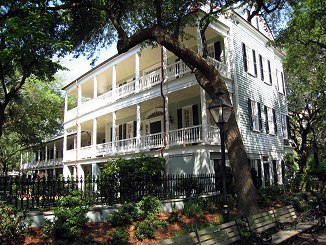
One Of The Insanely Lovely Buildings At The College of Charleston
It just so happened the College of Charleston had recently ramped up its interest (and dollar expenditures) in science programs. A hulking, extremely well-equipped modern science center had been constructed a year or so prior to my entrance. The geology program itself was also quite new, and the teaching staff was stocked with freshly-anointed, gung-ho young PhD’s.
I blundered into an environment that focused purely on teaching, learning, and one-on-one experience. Most classes contained less than sixteen students, and the emphasis was on teaching, not research. A better experience would have been difficult to find.
I hung around the department day and night, as well as every summer. I was a lab assistant during the school year, and sawed rock slabs or made rock thin-sections in the summer…whatever I could do. During much of that time, I was interested in “hard-rock” geology. “Hard-rocker” is slang for a geologist who specializes in igneous or metamorphic rocks. This type of geologist spends a lot of time with thin-sections and a microscope, studying crystalline structures and other way-out stuff.
Towards the end of my degree program, I developed an interest in coal geology. I sought out the world’s foremost coal geologist…John C. Ferm, and discovered he was a professor at the University of South Carolina, a mere 100 miles up the road! It killed me to tell my favorite hard-rock professor at the CofC (who might have hoped I would become one of his igneous proteges), that I wanted to defect to “soft rock” geology, apply to graduate school, and study with Ferm.
I applied to the University of South Carolina masters program in Geology, and asked for a teaching assistantship. They turned me down.
Wow! Turned down for a state school in a state I was a resident of! That was tough.
The University of Kentucky
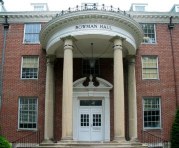
Bowman Hall – Department of Geology – University of Kentucky
I figured I had to get close to the coal. An application to the University of Kentucky was approved. Not only that, the geology department at Bowman Hall was willing to give me a sorely-needed teaching assistantship. On a quick visit to Lexington, I spotted two tons of coal proudly displayed right in the middle of the campus (the last time I checked, it was gone — probably a victim of “progressive” thought). This spectacular fossilized omen confirmed that UK would be a great place to spend a few years.
I got started under a wonderful professor…William C. MacQuown. He taught stratigraphy, and also happened to have twenty years experience in the oil business, including a stint as Sohio’s Chief Geologist in Oklahoma City. Dr. MacQuown certainly knew the practical side of geology, and he had a great interest in the Paleozoic, which just happened to be my favorite set of rocks. Very soon, I put coal geology on the back burner, and started thinking about stratigraphy. And, what a place to do it. The entire Paleozoic section is fantastically-exposed all around Lexington, Kentucky; some sections, for example the Ordovician, are world-renowned.
The next year, the news came that the geology department at UK had decided to hire an eminent coal geologist. I dropped my rock hammer when I discovered the new hire was none other than Dr. John C. Ferm!
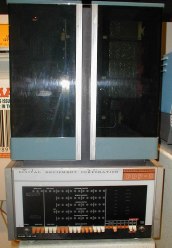
Digital Equipment Corporation (DEC) PDP-8 Minicomputer
Dr. Ferm soon showed up, but you might think the Rolling Stones had arrived for a concert.He blew into town accompanied by his very own PDP-8 minicomputer…with his own entourage…very unusual.The group included a PhD computer scientist — in charge of nursing the thing! Very few individuals actually owned computers at this time (the very first microcomputer was only two years old), and Ferm must have been one of the only guys in the world with his very own PDP-8. Ferm’s machine, four feet square, was ensconced in its very own building, across the street from Bowman Hall.
Even though I enjoyed a couple of courses in coal geology under Dr. Ferm, and actually served as his research assistant for a semester, I had finally decided to stick with stratigraphy and petroleum geology.
I did get to spend a fair amount of time in the room that housed the PDP-8. I watched in awe as the connected plotter spit out perfect..lovely…detailed schematics of coal-seam boreholes. I wanted to see a computer spewing my own oil-field maps and electric logs; something that would soon come to pass.
Cities Service Company (CITCO/CITGO)
 Near the end of my stay at UK, I got a phone call from Oklahoma. Jon Huffman asked me to come to Oklahoma City to interview for my first geologist job! Jon worked for a company called Cities Service Company. The company, better known as “Citco” or “Citgo,” was an 80-year old company with deep roots in the old Indian Territory. Cities’ huge mid-continent assets were a product of the early 1900’s oil boom in Oklahoma and Kansas, when the predecessor Indian Territory Illuminating Oil Company (ITIO) made many enormously successful (and quite romantic) discoveries.
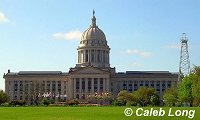
Vintage Derrick, OK State Capitol
I soon arrived in Oklahoma City to visit Cities Service. OKC was the center of oil exploration in the mid-continent, hosted a huge ongoing cowboy craze, and came complete with a laid-back atmosphere coupled with big-city amenities. “The City” sat atop the Anadarko Basin, one of the most prolific, romantic, oil and gas producing areas in the world. I liked it right off the bat. It also turned out to be the place where I would start my career!